Welcome to Websea
Your Gateway to Web3
明星交易员&跟随者福利(第一期) 带单冲榜赢 600USDT,跟单瓜分 4,000 USDT!
Websea上线 CC USDT 1-50倍 U本位永续合约
Websea上线 ALLO USDT 1-50倍 U本位永续合约
双11合约日|剁单不剁手,交易抢“大疆无人机”!
Websea第二期新币上线限时优惠,交易手续费享5折返还
明星交易员&跟随者福利(第一期) 带单冲榜赢 600USDT,跟单瓜分 4,000 USDT!
Websea上线 CC USDT 1-50倍 U本位永续合约
Websea上线 ALLO USDT 1-50倍 U本位永续合约
双11合约日|剁单不剁手,交易抢“大疆无人机”!
Websea第二期新币上线限时优惠,交易手续费享5折返还
明星交易员&跟随者福利(第一期) 带单冲榜赢 600USDT,跟单瓜分 4,000 USDT!
Breadcrumb: Home > Crypto Market Analysis > Content

Fed Cuts Rates by 25 Basis Points Again, Powell's Unexpectedly 'Hawkish' Stance Sparks Concerns, Where Will the Market Go?

Crypto 2025-10-30 106

On 30 October, the Federal Reserve's latest decision lowered the benchmark interest rate by 25 basis points to 3.75%-4.00%, in line with market expectations. However, the Federal Open Market Committee (FOMC) statement indicated that this interest rate decision encountered a rare situation of "hawks and doves both taking flight". Subsequently, Powell unexpectedly made a somewhat "hawkish" statement at the press conference, reducing expectations for whether the Fed can continue to cut rates in December, sparking market concerns. After the Fed's interest rate decision was announced, major global markets reacted strongly, with US stocks, US bonds, gold, and cryptocurrencies briefly plummeting during the session, while the US dollar rose. The Fed's October rate cut arrived as expected, but why can internal divisions still not be alleviated, what is the reason for Powell's unexpected "hawkish" statement, how should it be interpreted, and where will the market go next?

1. October rate cut arrives as expected, doubts remain over whether December can sustain rate cuts

In the early hours of today, the Federal Reserve announced its October interest rate decision, lowering the benchmark interest rate by 25 basis points to 3.75%-4.00%, marking the second consecutive meeting with a rate cut, in line with market expectations. This is also the fifth rate cut since September 2024. However, the subsequent FOMC statement and a series of statements from Powell's press conference lowered expectations for whether the Fed can continue to cut rates in December, sparking market concerns.

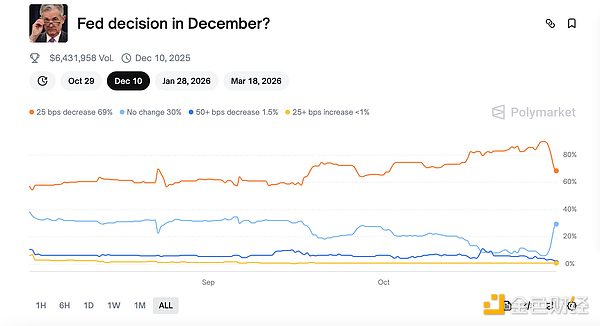
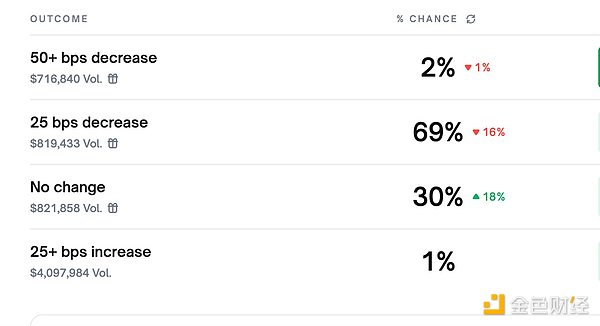
According to the latest CME "FedWatch", the probability of the Fed cutting rates by 25 basis points in December is 67.8%, while the probability of keeping rates unchanged is 32.2%. The probability of the Fed cumulatively cutting rates by 25 basis points by next January is 56%, the probability of keeping rates unchanged is 21.5%, and the probability of cumulatively cutting rates by 50 basis points is 22.5%. Prediction market Polymarket data shows that the market is betting on the Fed's December interest rate decision. Before this decision was announced, the market bet on a 90% probability of another 25 basis point rate cut in December; after the decision was announced, this probability has dropped to 69%. Meanwhile, the market's bet on a pause in rate cuts in December has risen to 30%.

After this interest rate decision was announced, major global asset markets reacted strongly. US stocks, US bonds, gold, and cryptocurrencies briefly plummeted during the session, with Bitcoin and Ethereum both falling over 3% at one point. US bond yields rose sharply across the board, with the 2-year and 10-year yields both rising over 10 basis points, and the US dollar briefly returned above the 99 level. Nvidia hit another record high, closing up nearly 3%, with its market capitalisation exceeding $5 trillion. Ultimately, supported by Nvidia, the Nasdaq closed up 0.55%, the S&P 500 index closed flat, and the Dow Jones fell 0.16%.

The market had long expected the Fed's October rate cut decision and also hoped it would stimulate the global economy and major asset markets. However, with the policy explanations from this FOMC statement and Powell's press conference, the market doubts whether the Fed can continue to cut rates in December, also sparking investor concerns.

2. FOMC statement still shows Fed internal divisions

This Federal Reserve FOMC statement announced that balance sheet reduction will end on 1 December. After ending balance sheet reduction on 1 December, redemption principal from mortgage-backed securities will be reinvested in short-term Treasury bonds. Starting from 1 December, all maturing US Treasury principal payments will be rolled over.

The FOMC statement also announced a reduction in the discount rate from 4.25% to 4%, and a reduction in the overnight reverse repo rate from 4% to 3.75%. The statement indicated that existing data show the economy is expanding at a moderate pace, and uncertainty about the economic outlook remains high. Inflation has risen somewhat this year and remains elevated. The Committee is closely monitoring risks to both sides of the dual mandate, believing that downside risks to employment have increased.

The Federal Reserve FOMC statement shows that this Fed interest rate decision encountered a rare situation of "hawks and doves both taking flight". Federal Reserve Governor Stephen Milan advocated for a more aggressive rate cut for the second consecutive meeting, arguing for a 50 basis point cut instead of the actual 25 basis point cut; meanwhile, Kansas City Fed President Schmid stood on the hawkish side opposing any rate cuts, advocating for keeping rates unchanged; other governors all voted in support of this Fed interest rate decision. This kind of meeting with two-way dissent last appeared in September 2019, reflecting significant divergence in the Fed's internal judgment of the economic outlook.

The FOMC statement shows obvious internal divisions within the Fed, indicating that during the US government "shutdown" and in the absence of a large amount of important economic data for reference, the Fed lacks a clear and unified understanding in judging the economic situation and formulating future policies.

3. Powell's unexpectedly "hawkish" statement sparks concerns

Federal Reserve Chairman Powell subsequently explained this rate cut decision and the economic situation at a press conference and answered reporters' questions. Powell stated that existing data indicate the US economic outlook has not changed much and is expanding moderately. Data before the shutdown showed the economy might be moving towards a more solid track; the government shutdown will temporarily drag on economic activity. He said inflation levels remain slightly high, and recent inflation expectations have risen somewhat; the Fed needs to manage the risk of inflation persisting longer and has a responsibility to ensure it does not become a persistent issue.

Regarding the impact of tariff issues, Powell said that under a reasonable baseline scenario, the impact of tariffs on inflation will be temporary. Addressing labour and employment issues, Powell stated that the labour market seems to be gradually cooling; existing evidence indicates that layoffs and hiring numbers remain low; downside risks to employment seem to have increased. He said state unemployment benefit claim data signal business as usual; low unemployment benefit claim numbers indicate the labour market is only gradually cooling, not significantly and rapidly declining; if data show improvement in the job market, it will affect decisions.

Regarding the Fed ending balance sheet reduction, Powell said money market pressures require immediate adjustment of balance sheet operations; December will enter the next phase of the balance sheet, which will remain stable in the short term. Money market liquidity has tightened over the past three weeks, and continuing balance sheet reduction offers little benefit; bank reserves are only slightly above ample levels, and balance sheet decisions give the market some adaptation time. He said there have been "clear signs" indicating it is time to stop quantitative tightening; the reinvestment strategy will bring the weighted average maturity closer to the outstanding securities stock.

Regarding this Fed interest rate decision, Powell provided an explanation. Powell stated that no significant deterioration has occurred in any sector of the economy, and overall, the economic situation is very good. He said he believes the Fed has taken the right actions so far this year. Powell reiterated that there is no zero-risk policy path, and the balance of risks has shifted. The Fed's rate cut is "another step towards a more neutral policy stance"; risk management logic also applies to today's rate cut, with the October cut having the same risk management logic as the September cut. He said the Fed cannot rely on just one tool to address both employment and inflation risks.

Powell also stated that a December rate cut is "far from" a done deal, hinting that the Fed is uncertain about whether to continue cutting rates in December. Market expectations for an October rate cut have been exhausted, still hoping the Fed can sustain rate cuts in December to stimulate further rises in major assets, but Powell's unexpectedly "hawkish" statement has cast a shadow over market confidence.

4. How to interpret the Fed's decision this time

Regarding this Fed decision, "Fed whisperer" Wall Street Journal reporter Nick Timiraos commented on Federal Reserve Chairman Powell's speech, saying: "Powell's press conference indicates that the FOMC as a whole does not agree with the market's previous high pricing for a December rate cut." Nick Timiraos said the October FOMC meeting was somewhat different in the following aspects. September's dot plot showed divisions within the Committee: most favoured continuing rate cuts as a risk management tool, but a significant portion saw no need for rate cuts. Normally, data can help reconcile this divergence. However, with fewer high-level data points to refine the outlook between FOMC meetings, members have fewer reasons to change their positions.

Inflation Insights analyst Omair Sharif believes the US government shutdown and lack of related official economic data may hinder the Fed's plan for a third consecutive rate cut in December. If there are no official data reflecting October and November economic activity when the meeting is held on 10 December, officials may not feel comfortable cutting rates again. They may find it difficult to reach consensus on another rate cut, especially considering the internal FOMC divisions shown in September's dot plot.

Analyst Joseph Richter said: "After Powell said a December rate cut is far from a done deal, the yield curve's bear flattening seems a bit overdone in our view." "Although the Fed may not cut rates at every meeting (though we think they will), we believe this statement is an attempt to regain optionality. The market will see this as hawkish, but it may not achieve that."

BNY Mellon Investment Management chief economist and former Fed senior advisor Vincent Reinhart believes, given the data vacuum, "the data must prove further easing is unjustified, which is a high bar", so he added, "It's really hard for them not to cut in December. It's easier to keep going than to stop."

Purdue University business school dean and former St. Louis Fed president James Bullard believes the prospect of a December rate cut is "a bit more nuanced than the market currently thinks". He noted that strong consumer spending and economic growth, coupled with recent inflation setbacks, could be reasons to slow the pace of rate cuts. "You're betting too much on a slowdown in non-farm payroll reports," Bullard said. He also questioned whether policymakers have truly adapted to the new normal where adding 50,000 jobs per month is "perfectly acceptable".

Additionally, Trump criticised the Fed on Thursday, again targeting Fed Chairman Powell, accusing him of being slow to act on rate cuts. Trump mentioned "Jerome 'Too Late' Powell" in a speech in South Korea and said he would not let the Fed raise rates out of concern for inflation three years later. He expects the US economy to achieve 4% growth in the first quarter of 2026, far above economists' predictions. This statement highlights tensions between Trump and the Fed.

5. Where will the market go next?

After the Fed's October interest rate decision was announced, where should major asset markets, including cryptocurrencies, go next? The market made the following interpretations.

1. Glassnode expressed the view that the market continues to struggle above the short-term holding cost price (approximately $113,000), which is a key area for momentum confrontation between bulls and bears. If it fails to firmly re-establish above this level, it may further fall back to near the active investor realised price (approximately $88,000). Glassnode said the market's current calm is conditional, but if Fed actions deviate from expectations, this calm will become fragile.

2. MicroStrategy founder Michael Saylor gave the latest Bitcoin price prediction in an interview, expecting it to reach $150,000 by year-end and targeting $1 million in the next 4 to 8 years.

3. Matrixport posted that Bitcoin remains in range-bound consolidation; in contrast, US stocks have repeatedly hit record highs driven by the AI boom. There is some similarity to the rhythm seen last year: after a long period of low volatility consolidation, prices once rose relatively quickly in about three weeks. The current narrow fluctuations place higher demands on traders' patience. Short-term positions should mainly wait and see, with the medium-term pattern unchanged. If the Fed maintains a dovish bias and continues to cut rates, the market will mostly reflect waiting for clearer external driving signals. Historically, similar rhythms are common: after prolonged consolidation, volatility tends to concentrate and release in a short period.

4. Crypto analyst @IamCryptoWolf posted on social media that ETH is undergoing an expanding wedge retest, with previous resistance levels now acting as solid support. November looks set to show steady consolidation, with a possible breakout at the end of the month, accelerating in December.

5. Angeles Investments chief investment officer Michael Rosen said this rate cut was within market expectations, but Powell's remarks dampened market optimism for another rate cut in December. Powell's statement reflects tensions within the Fed over whether to cut rates further, especially with inflation still high and exceeding the Fed's own target. Investors should expect inflation to remain elevated for a longer period, which will limit the extent of further monetary easing. Affected by these remarks, stocks retreated because investors had expected more rate cuts to provide a boost. But this is only a temporary reaction. Ultimately, what drives stocks is corporate earnings, and earnings performance remains strong, so we remain fully invested in our portfolio.

6. Investment firm Aureus Asset Management said the market expects the Fed to cut rates at least until December, but risks of rising inflation remain high. Despite all tariff negotiations, prices remain high. We have been focusing more on fixed income, finding its volatility can actually be reduced, rather than just being long stocks as in the past.